Mind to Voice: The AI Breakthrough That Could Give Speech Back
Imagine being fully aware, fully intelligent, and fully yourself — but unable to move your mouth or speak. Mind-to-voice technology is trying to solve that heartbreaking gap by turning brain signals into words, text, and synthetic speech.
What Mind-to-Voice Technology Actually Is
Mind-to-voice is the attempt to restore communication by decoding brain activity related to intended speech. It combines neuroscience, brain-computer interfaces, machine learning, language prediction, and speech synthesis into one communication system.
This is not magic and it is not random mind reading. The practical goal is focused: detect the brain patterns that appear when a person is trying to speak, then translate those patterns into words or a synthetic voice.
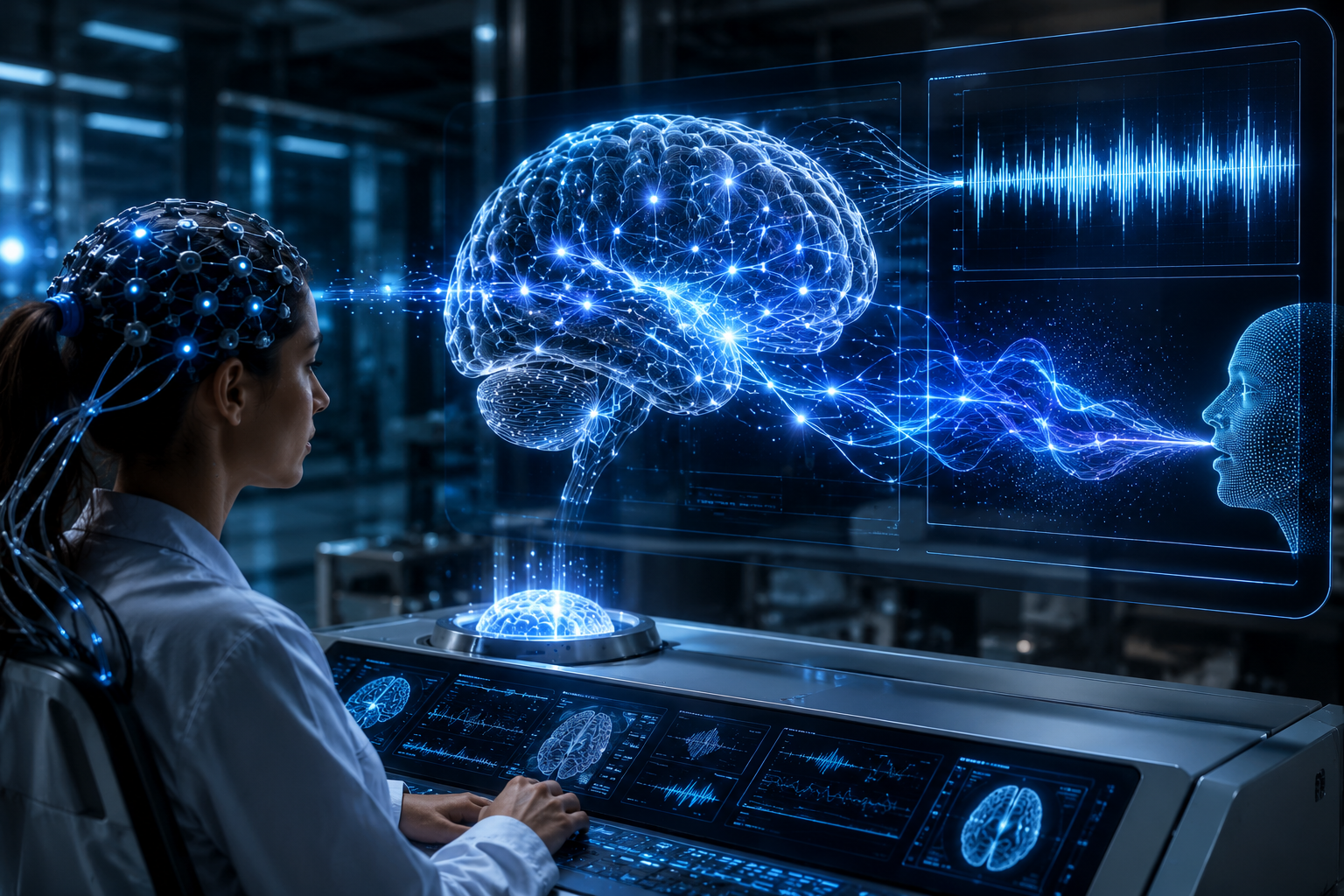
AI speech decoders search for repeatable neural patterns connected to intended speech.
The Core Pipeline: Brain Signal to Spoken Output
The system works like a translation chain. Each stage must be reliable, because one weak link can turn a powerful medical tool into a frustrating experience.
How the Brain Builds Speech Before You Say a Word
Speech begins before sound. Your brain first decides what you mean, builds a language plan, chooses words, prepares sounds, and creates a motor plan for your tongue, lips, jaw, throat, and breathing. In healthy speech, that plan becomes audible sound almost instantly.
For someone with ALS, paralysis, or locked-in syndrome, the speech plan may still exist, but the muscles cannot carry it out. That is where brain-computer interfaces become powerful. They try to capture the plan before the body fails to express it.
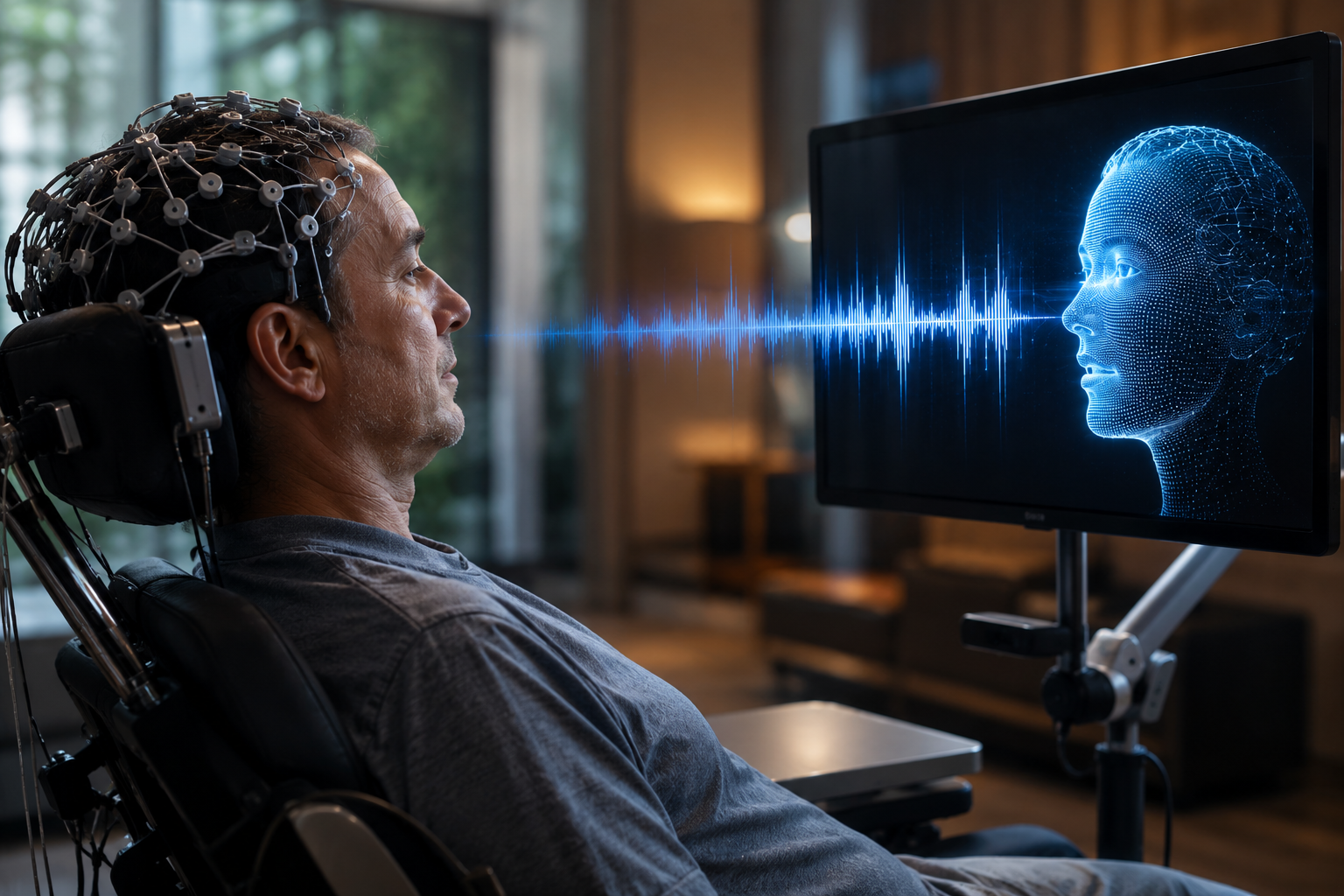
For ALS patients, communication is not a luxury. It is independence, identity, and dignity.
Why This Could Be Life-Changing for ALS
ALS can damage the nerves that control voluntary movement. A person may gradually lose the ability to speak while their thinking remains intact. That is a brutal disconnect: the mind is still there, but the body cannot deliver the words.
Existing tools like eye-tracking keyboards and switch devices can help, but they can also be slow, tiring, or impossible to use as movement declines. A speech neuroprosthesis could eventually provide faster, more natural communication.
How Brain Signals Are Captured
Different brain-computer interfaces capture different levels of detail. The tradeoff is simple but serious: the cleaner the signal, the more invasive the system often becomes.
| Method | How It Works | Strength | Limit |
|---|---|---|---|
| EEG | External sensors on the scalp record electrical brain activity. | Non-invasive and easier to wear. | Signals are weaker and blurrier because the skull and skin filter activity. |
| ECoG | Electrodes sit on the brain surface under the skull. | Cleaner signal than EEG. | Requires surgery and medical oversight. |
| Implanted Microelectrodes | Tiny electrodes record from small neural populations. | High-resolution data for precise decoding. | Most invasive and hardest to scale safely. |
| Future Wearables | Advanced non-invasive sensors attempt better signal capture. | Could become more practical for daily use. | Still not as clean as direct neural recordings. |
How AI Turns Neural Activity Into Speech
The AI model is trained by matching brain activity to known speech attempts. A participant may try to say prompted words or sentences while the system records their neural patterns. Over time, the model learns which patterns are linked to sounds, words, speech movements, or entire phrases.
Some systems decode phonemes, which are the sound building blocks of speech. Others decode attempted mouth movements. Others combine neural decoding with language prediction, so the system can choose the most likely sentence from noisy brain data.
- Signal cleaning: removes noise and irrelevant activity.
- Feature extraction: finds useful patterns inside the neural data.
- Model training: teaches the AI what brain patterns map to speech units.
- Language correction: improves the final sentence using context.
- Voice synthesis: converts the decoded message into spoken audio.
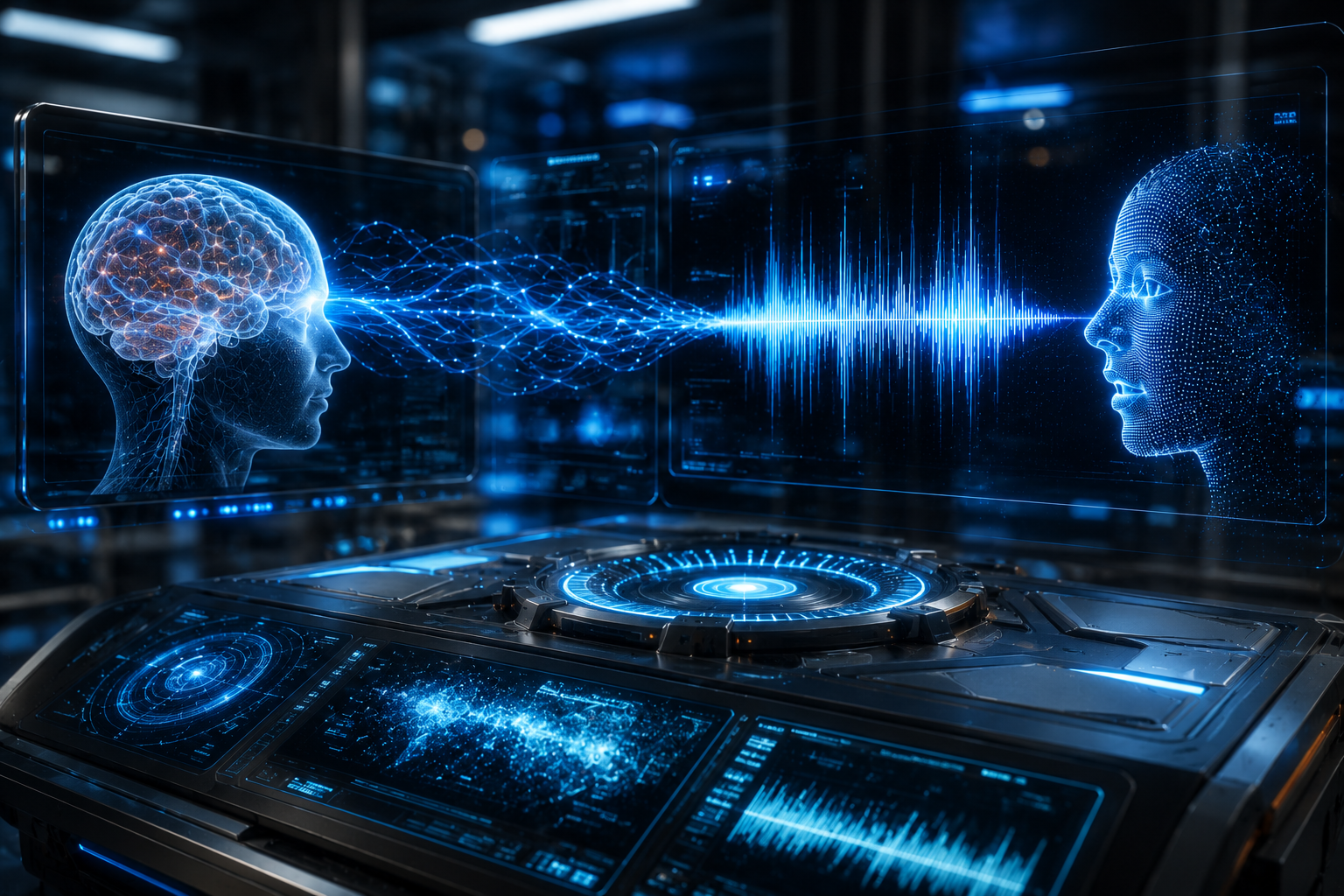
AI speech synthesis turns decoded intent into text, voice, or a personalized synthetic speaker.
Listen: Mind-to-Voice Narration
Play the narrated version of this feature. This audio player points to your uploaded file at /audio/mind-to-voice-narration.mp3.
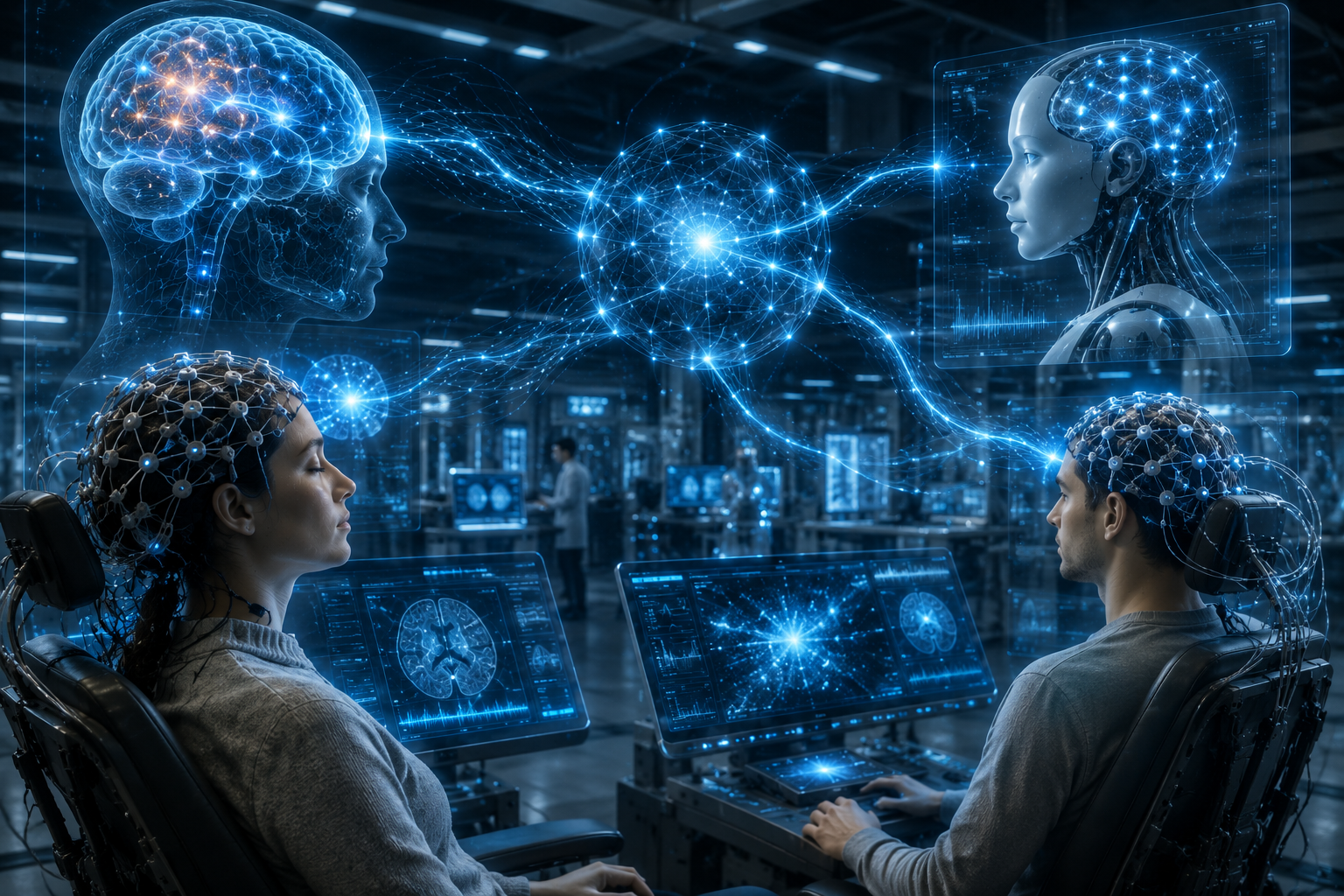
Future systems may connect neural communication with AI assistants, smart homes, robots, and medical devices.
Where This Technology Could Go Next
Mind-to-voice is likely to grow first as a medical assistive technology. After that, it may expand into smart home control, robotic assistance, caregiver alerts, and AI companion systems for people with severe mobility limits.
The ambitious future is direct human-AI communication, where a person can control software, robotics, or digital environments with neural intent. That future is exciting, but it must be built carefully. Brain data is not ordinary data. It deserves stronger protection than passwords, browsing history, or location data.
The Risks: Privacy, Errors, and Overhype
This technology is groundbreaking, but it is not finished. It still has problems with accuracy, training time, signal quality, cost, surgery risk, long-term reliability, and privacy. A decoder can misunderstand the user. A language model can guess wrong. A system can become frustrating if the user has to correct it constantly.
Video Gallery: Brain-Computer Interfaces, AI Speech & Neural Tech
These video cards open directly on YouTube in a new tab. This avoids broken iframe embeds when a creator or channel blocks outside playback.
Brain-Computer Interface Helps Decode Internal Speech
Researchers show how implanted brain-computer interface technology can help decode internal speech patterns.
ALS Speech Restoration Research
Opens a targeted YouTube search for ALS speech-restoration videos so you are not stuck with a dead embed.
AI Synthetic Voice + Neural Communication
Opens a focused YouTube search for synthetic voice, speech decoding, and neural-interface explainers.
Study Links & Search Ideas
Use these search terms to continue learning: brain-computer interface speech decoding, neural speech prosthesis, ALS communication BCI, ECoG speech decoder, implanted BCI communication, synthetic voice restoration, neural data privacy, locked-in syndrome communication technology.