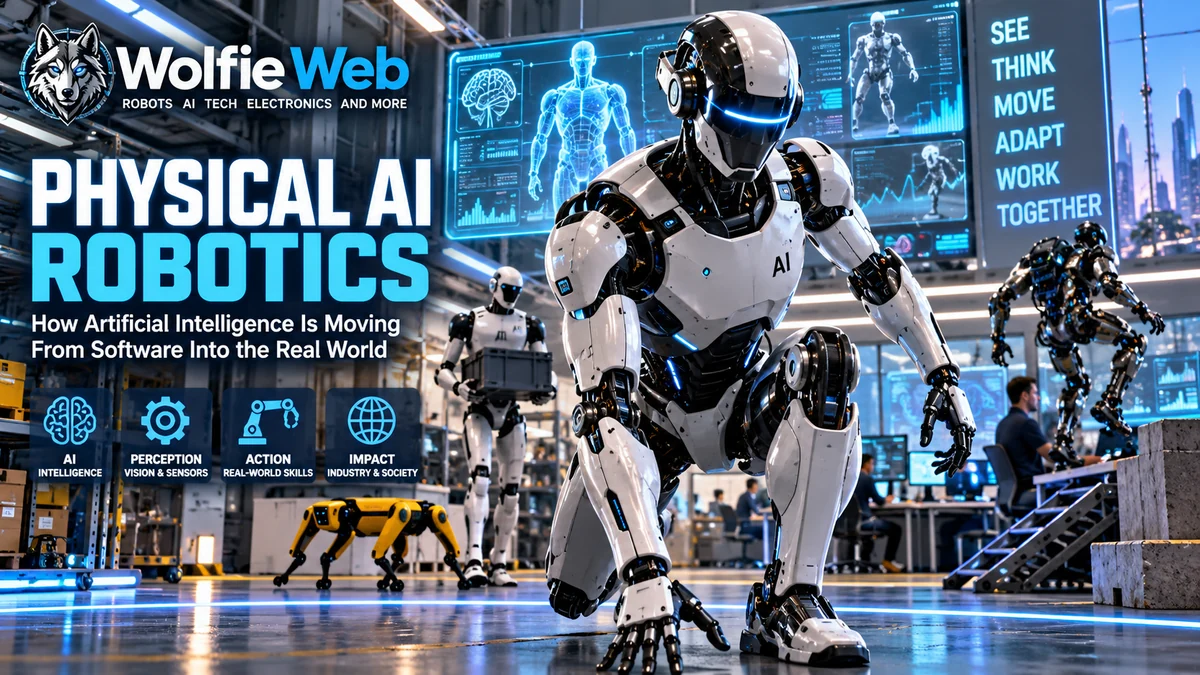
What exactly is physical AI?
Physical AI refers to artificial intelligence used by machines that perceive and act in the physical world. Unlike a chatbot working entirely with digital information, a physical AI system must deal with objects, spaces, forces, people and constantly changing conditions.
A robot may need to recognize a box, estimate its weight, decide where to grip it, move its arm and recover if the box slips. Each step involves uncertainty that software-only tasks do not face.
The big idea: Physical AI connects intelligence to action. A machine must not only decide what to do, but also execute that decision reliably in the real world.
How a physical AI robot works
👁️ Perception
Cameras, depth sensors and other instruments help the robot estimate what is around it.
🧠 Planning
AI models and control software select goals, movements and possible next actions.
🦾 Motion
Motors, joints, grippers and balancing systems turn commands into physical movement.
🔁 Feedback
Sensor readings help the robot correct mistakes and respond when conditions change.
Why robots are so much harder than chatbots
A language model can generate several possible answers in seconds. A robot has to choose actions under physical constraints. A poor response in a chat might be inconvenient; a poor movement near a person or heavy object can cause injury or damage.
Robots also face the sim-to-real gap: a behavior learned in simulation may fail on real floors, under unfamiliar lighting, or when objects are slippery or oddly shaped. Training in diverse environments, better sensors, careful testing and robust controls all help narrow that gap.
The humanoid robots bringing physical AI into focus
Humanoid robots attract attention because many human workplaces already have stairs, doors, shelves and tools designed around the human body. But a human shape is not always the best engineering choice: wheeled mobile robots and specialized industrial arms can be more efficient for many tasks.
- Boston Dynamics Atlas: an example of advanced whole-body movement and manipulation research. Explore Atlas in the Robot Database.
- Agility Robotics Digit: designed around moving materials in logistics settings. Explore Digit.
- Apptronik Apollo: a humanoid platform aimed at industrial work. Explore Apollo.
- Figure robots: an example of companies developing general-purpose humanoid systems. Explore Figure robots.
Capabilities, deployment status and specifications evolve rapidly. Check manufacturers' official announcements for the latest verified demonstrations and commercial details.
Where physical AI could make a difference
Warehouses and factories
Robots can assist with repetitive material movement, inspection and machine tending. Real deployments depend on speed, reliability, safety and cost—not just impressive demonstrations.
Healthcare and assistance
Assistive robotic systems could support transport and routine tasks, while rehabilitation robots already demonstrate the value of carefully controlled movement. Close human interaction requires particularly strong safety and oversight.
Homes and public spaces
Household environments are unpredictable: toys on the floor, pets, different furniture and changing layouts make general-purpose home robotics especially difficult. Useful home robots will need to handle those variations without constant supervision.
What must improve before robots become commonplace?
- Reliability: working repeatedly, not just once in a polished demo.
- Safety: detecting people, limiting forces and stopping when uncertain.
- Dexterity: manipulating varied objects without breaking or dropping them.
- Energy efficiency: balancing battery life, payload and operating costs.
- Adaptability: handling unfamiliar places and tasks without extensive reprogramming.
- Trust and accountability: clear rules for privacy, supervision and responsibility when something goes wrong.
Does physical AI mean robots will replace everyone?
Automation can change jobs and may replace some tasks, but its impact will vary by industry, economics, regulation and how systems are deployed. Many environments will continue to need people for judgment, maintenance, exceptions, coordination and care. The important question is not just what a robot can demonstrate, but what it can do safely and economically day after day.
The next frontier
The most exciting future for physical AI is not necessarily a robot that looks perfectly human. It is a machine that can learn useful skills, explain its limitations and perform real work without creating new risks. Progress will likely come through combinations of better AI models, improved hardware, simulation, data and practical field testing.
For readers following this field, the best evidence is independent testing, repeatable performance and real deployments—not promotional videos alone.
🤖 Explore the WolfieWeb Robot Database →