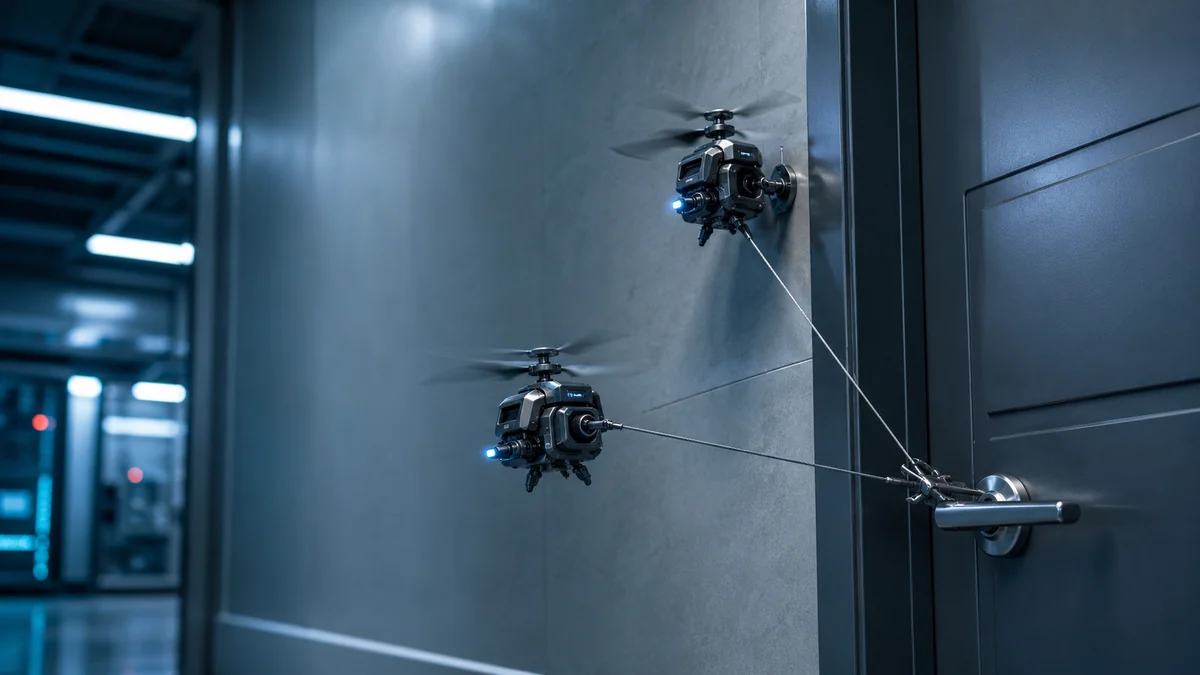
A flying robot that refuses to stay weak
A closed door is usually a hard stop for a tiny drone. FlyCroTug changes that by combining flight with physical anchoring. Instead of trying to muscle everything through propeller force, the robot grabs a surface, unreels a cable, and turns itself into a flying winch.
Two FlyCroTugs can coordinate around a door handle, pull from different angles, and open a door that would be impossible for a normal micro drone to push through. That is the trick: teamwork plus anchoring turns a small flying robot into a useful tool.
How FlyCroTug gets its strength
FlyCroTug borrows from biology and engineering at the same time. On smooth surfaces, it uses gecko-inspired adhesive pads. On rough surfaces, it can use tiny hook-like microspines. Once attached, a winch system lets it pull cable instead of relying only on the thrust of its propellers.
Why this matters
Small drones are great at reaching places people cannot easily enter, but they usually struggle when the job requires force. FlyCroTug attacks that weakness directly. By anchoring first and tugging second, the robot can do useful work after it arrives.
That changes the mission
A normal micro drone can observe. A FlyCroTug-style robot can interact. That difference is huge. It means a future rescue robot could slip into a damaged structure, pull a small object out of the way, place a camera where firefighters need visibility, or help guide a cable into position.
This is not a household robot ready to replace your hands tomorrow. Right now, FlyCroTug is still an advanced research project rather than a commercial product, but the technology points toward a future where tiny robots can do much more than simply fly and observe.
Video section: see the idea in motion
Watch FlyCroTug robots anchor themselves, pull with cables, and work together to move objects far larger than their size. These demonstrations make the engineering concept much easier to visualize.
Study links
Share this WolfieWeb article
FlyCroTug shows how future robots may become far more capable by working with their environment instead of fighting against it.