String Theory Crisis? Dark Energy Could Break Physics
Dark energy is one of the biggest mysteries in modern science. It describes the unknown force or property causing the universe’s expansion to speed up. By the end of this guide, you will understand why that simple-sounding idea creates a major headache for string theory.
Start Here: Space Itself Is Stretching
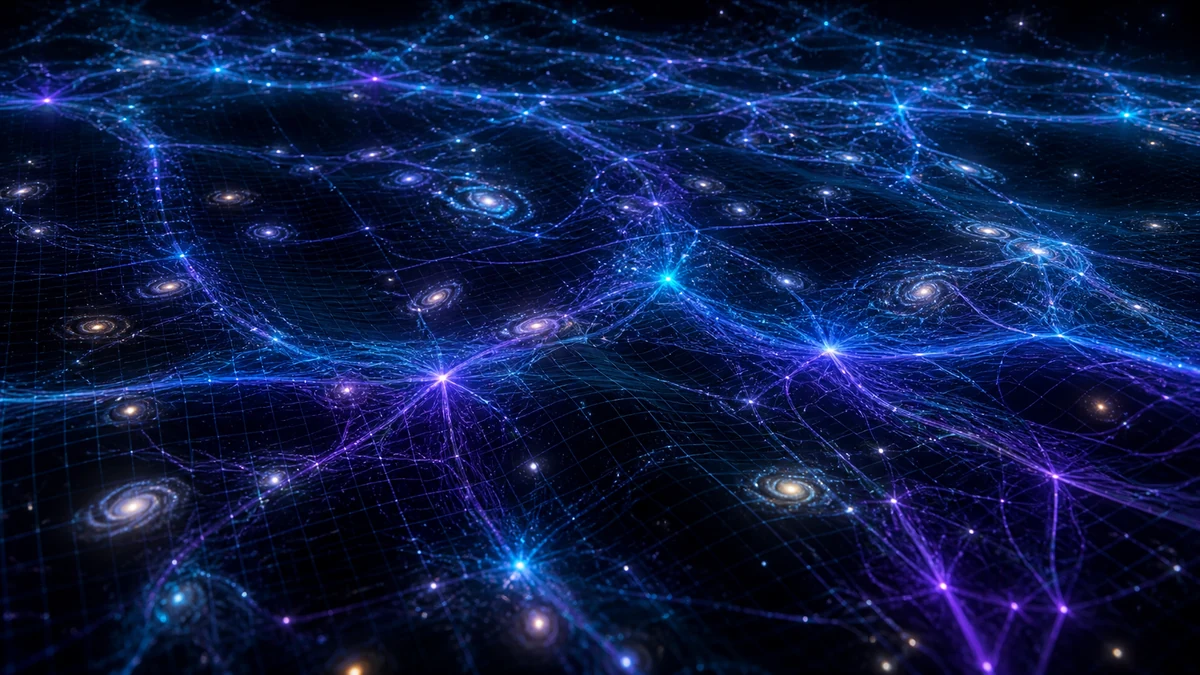
When you hear “the universe is expanding,” do not picture galaxies flying through space like shrapnel from an explosion. The better picture is stranger: space itself is stretching, and that stretching carries distant galaxies farther apart.
Earth, the Solar System, and the Milky Way are held together by gravity. Expansion matters most across huge cosmic distances.
The farther away a galaxy is, the more stretched space lies between us and it.
Measurements of distant supernovae showed that expansion is not merely continuing — it appears to be speeding up.
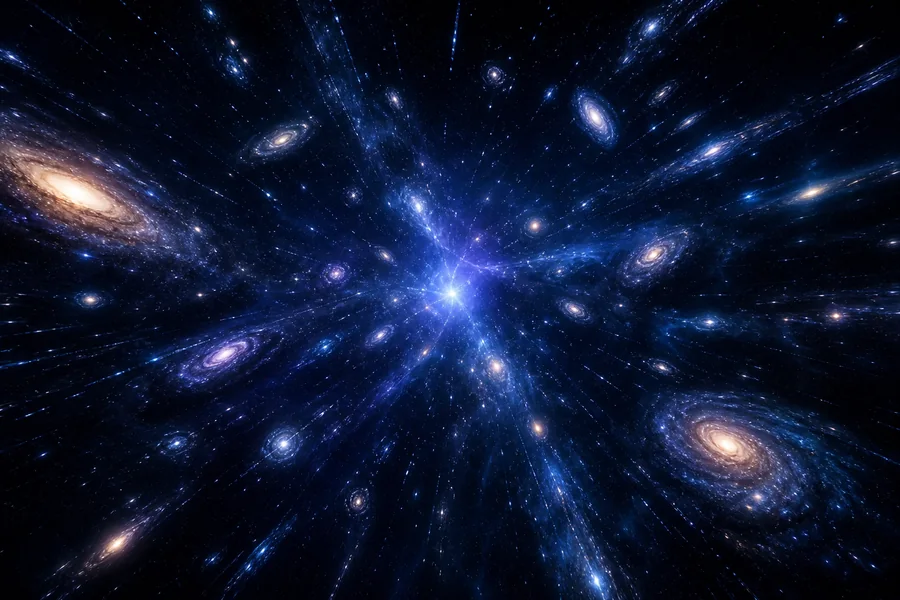
A visual model of galaxies drifting apart as spacetime stretches between them.
What Is Dark Energy?
Dark energy is a placeholder name for the unknown cause of accelerated cosmic expansion. It makes up most of the universe’s total energy budget, but scientists still do not know whether it is a constant property of empty space, a changing field, or a sign that gravity needs a rewrite on cosmic scales.
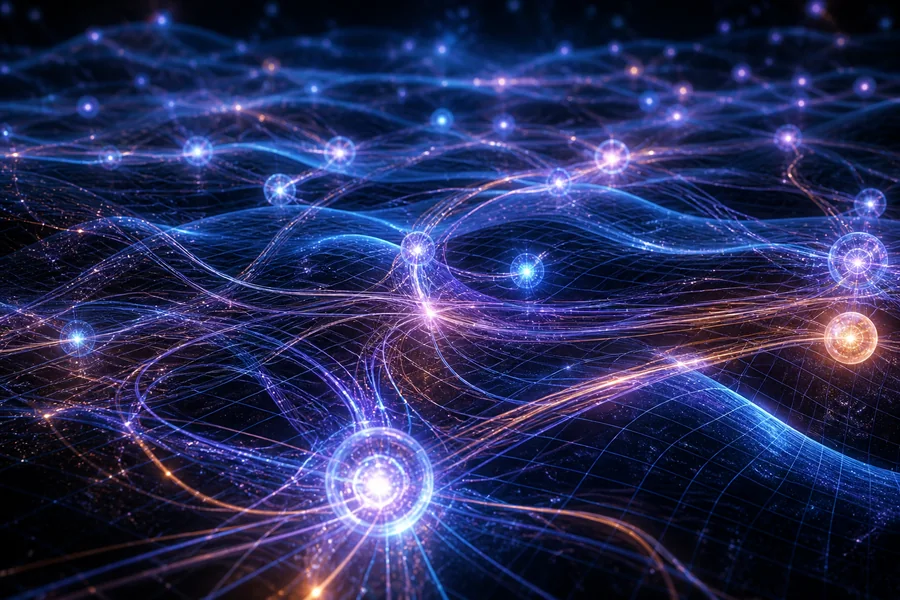
String theory often needs hidden extra dimensions. Dark energy asks whether those dimensions can produce the universe that astronomers actually observe.
Why String Theory Gets Pulled Into the Fight
String theory tries to replace point particles with tiny vibrating strings. Different vibrations would appear as different particles. That sounds elegant, but the math usually needs extra spatial dimensions curled up so small that ordinary human senses and current instruments do not see them directly.
Here is the problem: the observed universe appears to have a small positive dark energy. In cosmology, that resembles a de Sitter-like universe. Building a stable de Sitter universe inside string theory has been extremely difficult. That is where the controversy starts.
The Swampland Debate: The Safe Zone vs. The Bad Zone
The “swampland” is a nickname for theories that look reasonable at low energy but cannot exist inside a complete theory of quantum gravity. The “landscape” is the set of possible universes that string theory might allow. The big question is whether the dark-energy universe astronomers observe sits in the landscape — or sinks into the swampland.
Landscape
The set of possible low-energy universes that may be consistent with string theory and quantum gravity.
Swampland
The set of tempting but ultimately inconsistent models that cannot be completed into a real quantum-gravity theory.
de Sitter tension
The accelerating universe looks roughly de Sitter-like. Some swampland ideas suggest stable de Sitter space may not be allowed.
Why it matters
If dark energy is truly constant and string theory cannot support it, string theory has a serious problem. No sugarcoating that.
The Big Picture in One Minute
Here is the clean version: gravity should slow cosmic expansion because matter attracts matter. Instead, observations show that distant galaxies are separating faster over time. That means something is overpowering gravity on the largest scales.
Watch the Idea Click: Dark Energy, String Theory, and the Swampland
Use these short video lessons to see the idea from three angles: first the expanding universe, then the strange behavior of dark energy, then the string theory debate. Click any card to open the pop-out player without leaving the page.
Lesson 1
What Dark Energy Really Does
Start with the core idea: the universe is not just expanding — that expansion is accelerating.
Click to watch the pop-out lesson → Lesson 2
Why It Acts Like Cosmic Anti-Gravity
This connects pressure, gravity, and why empty space can push expansion instead of slowing it down.
Click to watch the pop-out lesson →
Lesson 3
String Theory: Landscape vs. Swampland
This is the bridge into the big controversy: which universes can consistent quantum gravity actually allow?
Click to watch the pop-out lesson →How to Understand This Without Getting Lost
The cleanest way to understand this subject is to climb the ladder one step at a time: first the observation, then the mystery, then the theory conflict. Do not start with string theory math. Start with what the sky is telling us.
The endgame question: does dark energy keep pushing forever, weaken over time, or reveal new physics?
What Happens Next?
The honest answer: nobody has the final answer yet. Better cosmic surveys, sharper dark-energy measurements, and better quantum-gravity math will decide whether string theory adapts or takes a serious hit.
Study Links & Search Terms
- NASA: What Is Dark Energy?
- DESI: Dark Energy Spectroscopic Instrument
- CERN: Extra Dimensions
- Search terms: swampland conjecture, de Sitter universe, quintessence, cosmic acceleration, quantum gravity, string landscape.