WOLFIEWEB

WolfieWeb Special Report · Chapter Two

The Global Humanoid Robot Arms Race

Who is building the future? Explore the worldwide competition and robots ranked #26–50.

The humanoid revolution did not begin with one announcement. It emerged simultaneously from laboratories, factories and startups across the world.

American companies are combining robotics with powerful AI models. Chinese developers are moving from prototypes toward scalable manufacturing. Japan continues to influence precision engineering and human-centered design. Europe contributes collaborative platforms, research systems and safety-focused engineering, while South Korea is drawing on its strengths in electronics and industrial automation.

Chapter Two maps that global race, then continues WolfieWeb’s ranking with twenty-five machines that reveal just how broad the field has become.

25robots in Chapter Two
10+countries and regions
20+robotics developers
1global race accelerating

Who is building the humanoid future?

Explore the engineering regions driving the global humanoid race. Select a node to reveal its companies, strengths and momentum.

WolfieWeb Global Command

Humanoid Robotics Activity Network

Live Industry Map
Major robotics hubDashed line = active technology corridor

Humanoids are entering real workplaces

The second video in this report focuses on the shift from laboratory demonstrations toward practical industrial work.

Robots ranked #26–50

Search by robot, company or country. Scores are WolfieWeb editorial ratings for this chapter.
#26
Unitree H2 Plus humanoid robot
Add /images/h2plus_card.webp

Unitree Robotics · China

Unitree H2 Plus

Introduced2026Primary roleIndustrial, research and logistics humanoidWolfieWeb score88/100

Unitree’s H2 Plus extends the company’s fast-moving humanoid program with a larger, more capable platform aimed at research and practical work. It combines dynamic bipedal motion, AI-ready computing and dexterous manipulation in a design intended for laboratories, logistics and industrial experimentation. Its significance is less about one spectacular trick than Unitree’s ability to iterate quickly and place advanced hardware within reach of more developers.

#27
RealMan RM65-H humanoid robot
Add /images/rm65h_card.webp

RealMan Robotics · China

RealMan RM65-H

Introduced2025Primary roleCollaborative industrial manipulationWolfieWeb score87/100

RealMan’s RM65-H emphasizes dependable manipulation, modularity and collaboration. The platform is built around accurate robotic arms, perception and task flexibility rather than acrobatics. In factories and laboratories, that focus matters: useful humanoids must handle tools, inspect components and work around people without demanding a complete redesign of the facility.

#28
PAL Robotics TIAGo++ humanoid robot
Add /images/tiago_card.webp

PAL Robotics · Spain

PAL Robotics TIAGo++

Introduced2025Primary roleResearch, healthcare and service roboticsWolfieWeb score86/100

TIAGo++ brings mobile manipulation, autonomous navigation and human-robot interaction into one flexible platform. Universities and research laboratories use PAL Robotics systems to test perception, assistance, healthcare workflows and service robotics. Its wheeled base sacrifices bipedal spectacle for stability, runtime and practical indoor operation.

#29
PUDU D7 humanoid robot
Add /images/d7_card.webp

PUDU Robotics · China

PUDU D7

Introduced2026Primary roleIndustrial logistics and material handlingWolfieWeb score85/100

PUDU D7 takes a semi-humanoid route: a human-like upper body rides on a fast omnidirectional base. That combination allows the robot to move efficiently through warehouses and factories while still using two articulated arms for handling, sorting, inspection and machine interaction. It shows that the most useful “humanoid” form may not always require two legs.

#30
DroidUp Moya humanoid robot
Add /images/moya_card.webp

DroidUp · China

DroidUp Moya

Introduced2026Primary roleHealthcare, education and public-facing serviceWolfieWeb score84/100

Moya explores the social side of humanoid robotics. Its biomimetic face, natural eye contact and expressive movement are designed for healthcare, education, hospitality and public-facing assistance. The technical challenge is not raw strength but trust: a service robot must read the room, communicate clearly and behave predictably around vulnerable or unfamiliar users.

#31
Toyota T-HR3 humanoid robot
Add /images/thr3_card.webp

Toyota · Japan

Toyota T-HR3

Introduced2017Primary roleTeleoperation and remote human assistanceWolfieWeb score83/100

Toyota’s T-HR3 remains an important demonstration of telepresence robotics. A human operator controls the robot through a full-body maneuvering system while receiving force feedback from the remote environment. This approach keeps human judgment in the loop for disaster response, maintenance and hazardous work where full autonomy may not yet be dependable.

#32
LimX Dynamics Luna humanoid robot
Add /images/luna_card.webp

LimX Dynamics · China

LimX Dynamics Luna

Introduced2026Primary roleEmbodied AI research and manipulationWolfieWeb score82/100

Luna represents LimX Dynamics’ push toward a flexible, AI-ready humanoid platform. It combines dynamic motion, coordinated upper-body manipulation and multi-sensor perception. The platform’s value lies in giving researchers a physical system on which to train and test embodied intelligence in environments designed for people.

#33
HMND 01 Alpha humanoid robot
Add /images/hmnd01_card.webp

Humanoid · China

HMND 01 Alpha

Introduced2025Primary roleWarehouse and industrial automationWolfieWeb score81/100

HMND 01 Alpha is aimed at the unglamorous work that will determine whether humanoids succeed commercially: moving materials, tending equipment, inspecting work areas and completing repetitive tasks for long periods. Its industrial design prioritizes protection, stability and practical manipulation rather than a polished consumer appearance.

#34
UBTECH Walker C2 humanoid robot
Add /images/walker_c2_hero.webp

UBTECH Robotics · China

UBTECH Walker C2

Introduced2026Primary roleSmart manufacturing and embodied-AI researchWolfieWeb score80/100

Walker C2 continues UBTECH’s long-running humanoid program with a full-size industrial concept for manufacturing, inspection and logistics. Integrated sensing and articulated hands are intended to help the robot operate existing tools and workstations. The model’s public specifications remain limited, so its ranking reflects platform promise rather than proven fleet deployment.

#35
Astribot S1 humanoid robot
Add /images/astribots1_card.webp

Astribot · China

Astribot S1

Introduced2025Primary roleHigh-speed manipulation and service tasksWolfieWeb score79/100

Astribot S1 drew attention through rapid, smooth demonstrations involving cooking, sorting and folding. Its strongest argument is that useful manipulation may create value before perfect bipedal walking does. By prioritizing arm speed, perception and imitation learning, S1 targets everyday tasks that demand coordination more than heavy lifting.

#36
EngineAI PM01 humanoid robot
Add /images/pm01_card.webp

EngineAI · China

EngineAI PM01

Introduced2024Primary roleEmbodied intelligence and motion researchWolfieWeb score78/100

PM01 is a compact humanoid built to explore natural movement and embodied AI. Its demonstrations emphasize coordinated walking, balance and expressive full-body control. Smaller platforms such as PM01 can lower the cost of experimentation while helping developers train motion policies and manipulation systems before scaling to larger robots.

#37
PNDbotics TORA-ONE humanoid robot
Add /images/toraone_card.webp

PNDbotics · China

PNDbotics TORA-ONE

Introduced2026Primary roleEmbodied-AI development platformWolfieWeb score77/100

TORA-ONE is positioned as a full-size platform for bipedal mobility, perception and manipulation research. Public details remain incomplete, but the robot reflects a broader trend: new companies are offering integrated humanoid hardware so AI teams can focus on training, task learning and application development rather than building every actuator from scratch.

#38
Fourier GR-2 humanoid robot
Add /images/gr2_card.webp

Fourier Intelligence · Singapore / China

Fourier GR-2

Introduced2024Primary roleResearch, healthcare and industrial collaborationWolfieWeb score76/100

GR-2 builds on Fourier Intelligence’s rehabilitation-robotics experience with improved hands, stronger actuation and a more open embodied-AI stack. The company’s background in biomechanics gives it a distinctive focus on smooth movement and safe interaction—qualities that matter in healthcare as much as in manufacturing.

#39
Fourier GR-1 humanoid robot
Add /images/gr1_card.webp

Fourier Intelligence · Singapore / China

Fourier GR-1

Introduced2023Primary roleHealthcare, education and humanoid researchWolfieWeb score75/100

GR-1 was Fourier Intelligence’s breakthrough humanoid platform. It translated years of rehabilitation engineering into a full-size robot for research, healthcare and general-purpose experimentation. While later models improve the hardware, GR-1 remains important because it established the architecture and developer ecosystem behind Fourier’s humanoid program.

#40
Kepler Forerunner humanoid robot
Add /images/kepler_forerunner_card.webp

Kepler Robotics · China

Kepler Forerunner

Introduced2025Primary roleGeneral-purpose embodied AIWolfieWeb score74/100

Kepler Forerunner is designed around the idea that a humanoid should gain value through software. Vision, mapping and learning systems are intended to let the platform acquire new tasks across manufacturing, logistics and service environments. Its promise rests on adaptability: one body capable of many jobs rather than one machine per workstation.

#41
Rainbow Robotics RB-Y1 humanoid robot
Add /images/rby1_card.webp

Rainbow Robotics · South Korea

Rainbow Robotics RB-Y1

Introduced2024Primary roleMobile manipulation and AI researchWolfieWeb score73/100

RB-Y1 combines two collaborative robotic arms with a mobile base, avoiding the energy and stability costs of bipedal walking. The result is a capable research platform for manipulation, teleoperation and embodied AI. Its design makes a practical point: mobility and human-like arms can matter more than human-like legs.

#42
Leju Robotics Kuavo humanoid robot
Add /images/kuavo_card.webp

Leju Robotics · China

Leju Robotics Kuavo

Introduced2024Primary roleEducation, research and industrial assistanceWolfieWeb score72/100

Kuavo is a full-size humanoid developed for embodied-AI research, education and industry. Its combination of dynamic locomotion and dexterous hands makes it useful for testing whole-body control and human-space interaction. Leju’s platform also illustrates the growing number of Chinese companies offering complete humanoid systems to developers.

#43
UBTECH Walker C1 humanoid robot
Add /images/walkerc1_card.webp

UBTECH Robotics · China

UBTECH Walker C1

Introduced2026Primary roleService, reception and commercial interactionWolfieWeb score71/100

Walker C1 shifts the Walker family toward commercial and public-facing environments. Its human-scale body, articulated arms and visual sensing support guidance, reception and demonstration work. Unlike factory-first models, it must balance capability with approachability and safe interaction around untrained members of the public.

#44
NASA Valkyrie humanoid robot
Add /images/valkyrie_card.webp

NASA · United States

NASA Valkyrie

Introduced2013Primary roleDisaster response and space explorationWolfieWeb score70/100

NASA’s Valkyrie, also known as R5, was built for disaster response and future off-world work. It helped researchers study human-scale locomotion, tool use and autonomous operation in difficult environments. Its hardware is older than many robots in this ranking, but its influence on space and field robotics remains substantial.

#45
MenteeBot humanoid robot
Add /images/menteebot_card.webp

Mentee Robotics · Israel

MenteeBot

Introduced2025Primary roleAI-first general-purpose assistanceWolfieWeb score69/100

MenteeBot is built around an AI-first philosophy. The goal is not merely to execute motion commands but to understand instructions, plan multi-step tasks and learn from demonstrations. That software emphasis places MenteeBot among the platforms testing whether foundation models can turn capable hardware into a broadly useful worker.

#46
Sophia humanoid robot
Add /images/sophia_card.webp

Hanson Robotics · Hong Kong

Sophia

Introduced2016Primary roleSocial interaction and public AI outreachWolfieWeb score68/100

Sophia is not an industrial worker, yet few humanoids have influenced public awareness more. Its expressive face and conversational performances brought social robotics into mainstream media. Sophia’s importance lies in human-robot interaction, facial actuation and the difficult question of how intelligent machines should present themselves to people.

#47
Pepper humanoid robot
Add /images/pepper_card.webp

SoftBank Robotics · Japan / France

Pepper

Introduced2014Primary roleCustomer service and social interactionWolfieWeb score67/100

Pepper greeted customers in banks, shops, museums and schools around the world. Its wheeled base and expressive upper body were designed for reliable indoor service rather than physical labor. Although the platform is now limited, it proved that organizations would deploy social robots at meaningful scale.

#48
Xiaomi CyberOne humanoid robot
Add /images/cyberone_card.webp

Xiaomi · China

Xiaomi CyberOne

Introduced2022Primary roleAI research and future consumer roboticsWolfieWeb score66/100

CyberOne marked Xiaomi’s entry into full-size humanoid robotics. It combined bipedal movement, perception and interaction experiments with the resources of a global consumer-electronics company. The prototype’s broader significance is strategic: companies with batteries, sensors, AI assistants and manufacturing scale may eventually become major humanoid players.

#49
1X NEO Gamma humanoid robot
Add /images/neo_gamma_card.webp

1X Technologies · Norway / United States

1X NEO Gamma

Introduced2025Primary roleHome and everyday assistanceWolfieWeb score65/100

NEO Gamma is built around domestic environments rather than factories. Soft coverings, quiet movement and a lightweight form are intended to make it safer around people and household objects. Home robotics is brutally difficult because every room and routine differs, making NEO Gamma an important experiment in adaptable, human-centered design.

#50
RobotEra XBot-L humanoid robot
Add /images/xbotl_card.webp

RobotEra · China

RobotEra XBot-L

Introduced2025Primary roleResearch and general-purpose embodied AIWolfieWeb score64/100

XBot-L closes Chapter Two as a representative of the rapidly expanding next tier of humanoid platforms. It combines full-body mobility, sensing and an AI development stack aimed at research and future industrial tasks. The robot’s significance is the ecosystem it represents: capable humanoid hardware is no longer limited to a handful of famous companies.

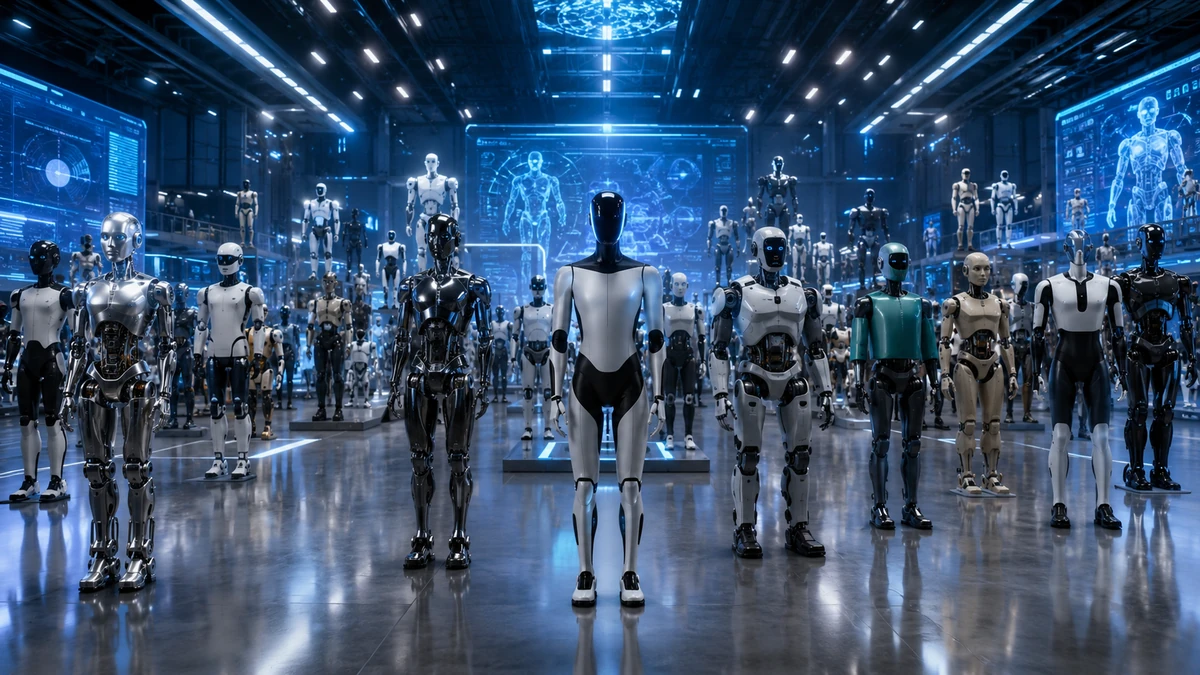
Humanoid robots working with engineers in a futuristic robotics facility

Chapter Two Conclusion

The race is accelerating

Only a few years ago, humanoid robots were mostly research machines. Today, they are sorting goods, testing factory workflows, assisting researchers and learning new skills through increasingly capable AI models. The field is no longer controlled by a handful of famous laboratories; it has become a worldwide engineering and manufacturing competition.

The next chapter continues with robots #51–75 and the technologies that may determine which platforms move from promising demonstrations to reliable everyday work.

← Chapter 1: Robots #1–25Chapter 3: Robots #51–75 · Coming next →